January 21, 2026 | Blog
How do revenue operations leaders stabilize and scale growth? 5 essentials explained

Revenue leadership often feels like playing Jenga during an earthquake. One wrong move, or one misaligned team, and the whole structure comes crashing down. A RevOps assessment is a blueprint for stabilizing and improving your revenue machine. Built on five pillars (strategy, data, analytics, process, and platforms,) this revenue operations (RevOps) approach looks past routine tech stack adjustments. It focuses on the conditions that consistently drive revenue and on how a disciplined RevOps strategy reinforces them.
What is a RevOps assessment, anyway?
Trying to build a skyscraper without checking the foundation wouldn’t get you far. Structural issues would stop everything fast. Running a revenue team without a RevOps assessment in place feels the same way. A RevOps assessment ensures your revenue operations foundation is strong enough to support growth and prevent breakdowns.
Why platforms alone don’t fix RevOps problems
Many leaders assume a RevOps assessment starts and ends with the tech stack. “We’ll add some AI and call it a day.” That rarely works. Tools matter, but they only work when revenue operations strategy and processes support them. Platforms without alignment across teams and data turn into expensive software no one fully uses.
A tech stack works like a Formula 1 car. The platforms are the car, the teams are the pit crew, and the race plan is your RevOps strategy. A powerful car alone won’t win races. You need trained people, clear strategy, and reliable data to make good decisions. Strong RevOps comes from getting all of those pieces working together so performance stays consistent.
Why every RevOps assessment needs a clear business lens
Before you dig into the five pillars of revenue operations, set a clear lens for the assessment. Decide what you want to fix, improve, or evaluate through your RevOps assessment. Without that focus, it’s easy to stall out in analysis.
Common lenses include:
- Pipeline health: Do we have enough account engagement to hit targets?
- Forecast accuracy: Why do our numbers keep coming in wrong?
- Customer retention: Is our renewal motion working, or are we losing customers?
Define the business case upfront so your RevOps assessment findings lead to action. Otherwise, you’re running diagnostics without knowing what you’re trying to repair.
What are the five pillars of a RevOps assessment?
Here’s how to examine your revenue engine through each pillar of revenue operations, ensuring your RevOps assessment is comprehensive and not just another tech audit:
1. Is your revenue strategy clear, aligned, and understood across teams?
Your RevOps strategy defines the why. Are your revenue goals clear? Does everyone on the revenue team (marketing, sales, finance, customer success) understand the game plan? Misalignment here trickles down into chaos everywhere else.
- What to assess: Revenue goals, GTM strategy, team alignment
- Red flags: Conflicting KPIs between departments or unclear goals
2. Is your revenue data trustworthy enough to drive decisions?
If strategy is the brain, data is the blood pumping through your RevOps veins. Every downstream revenue operations decision depends on it. Bad data inevitably leads to bad outcomes.
- What to assess: Data quality, accessibility, and governance
- Red flags: Duplicate records, siloed systems, or outdated information
3. Do your RevOps analytics actually answer “so what?”
Data without insights is just noise. RevOps analytics turn raw information into clarity, helping revenue operations teams connect the dots and answer the all-important question: so what?
- What to assess: Reporting accuracy, dashboards, and predictive models
- Red flags: Metrics that don’t drive action or reports no one reads
4. Can your revenue strategy be executed consistently through process?
Processes are what turn RevOps strategy and insights into repeatable action. Without them, even the strongest revenue operations plan breaks down at execution.
- What to assess: Cross-departmental workflows, SLAs, and operational efficiencies
- Red flags: Bottlenecks, inconsistent follow-ups, or manual inefficiencies
5. Are your RevOps tools enabling growth or just adding complexity?
Only after the revenue operations fundamentals are in place does technology matter. The right RevOps tools amplify strong strategy, clean data, clear insights, and solid processes, but they can’t compensate for gaps in any of them.
- What to assess: Platform adoption, integration, and scalability
- Red flags: Overlapping tools or underutilized software
Turning RevOps assessment insights into action
A RevOps assessment is only as good as its outcomes. The best revenue operations assessments lead to next steps that change how teams operate, how work flows, and how tools are used. Here’s how to move from assessment to action:
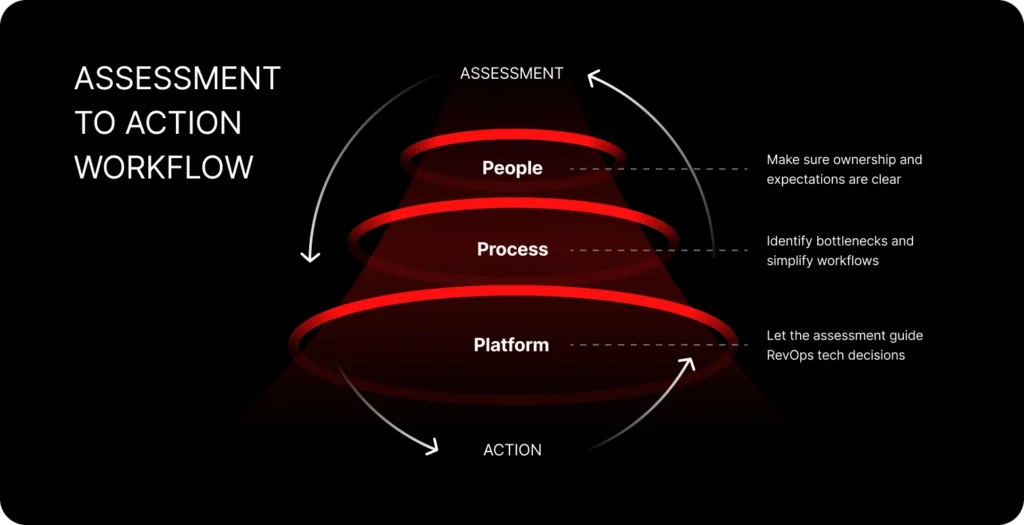
- People: Does your team have the skills and alignment needed to execute the RevOps strategy? Training helps, but clarity matters just as much. Make sure ownership and expectations are clear.
- Process: Use the RevOps assessment to identify where work slows down or breaks. Fix those bottlenecks first, then simplify workflows and reduce manual effort.
- Platforms: Let the assessment guide your revenue operations tech decisions. Remove tools that don’t pull their weight and make sure the remaining systems work together.
Pro tip: Don’t try to fix everything at once. Prioritize based on impact and feasibility.
Why RevOps assessments deliver long-term revenue gains
When a RevOps assessment is grounded in these five pillars, it avoids shallow audits and leads to steadier revenue outcomes. Revenue operations teams work with less friction, and the tech stack supports the business instead of fighting it.
As a revenue leader, your time is precious. Treat your RevOps assessment as a shortcut to clarity, one that improves alignment and execution, with revenue growth as the payoff.
Choose the right lens, involve the right people, and start the work. RevOps doesn’t have to stay chaotic. You already have the roadmap. If you need help getting started, talk to our experts.
Recent posts

Blog
How marketing drives B2B buyer enablement and growth

Blog
Blending ABM and demand generation, part 2: Hybrid marketing in action

Blog
Blending ABM and demand generation, part 1: The case for integration