February 12, 2026 | Blog
Blending ABM and demand generation, part 1: The case for integration
For years, B2B marketing treated demand generation and account-based marketing (ABM) as separate paths. One emphasized reach and volume. The other prioritized focus and depth.
In reality, many teams were already running both—often in parallel and without a shared operating model. That framing no longer reflects how buyers evaluate solutions or how revenue moves through an organization.
Some situations require market education and broad visibility through demand generation. Others need concentrated effort against a small set of accounts where deals are large and outcomes matter more than volume.
High-performing teams use a hybrid approach, deliberately shifting between each based on what the business needs at that moment.
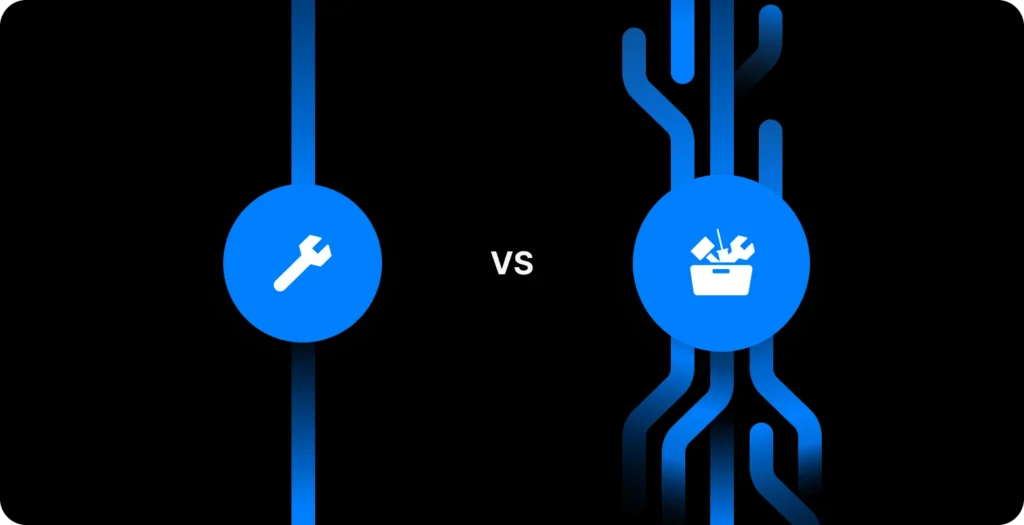
Think in terms of capability rather than preference. A single tool limits what you can fix. A well-equipped toolbox allows teams to match the motion to the job at hand and sustain growth over time.
Why integration works
What used to feel like two separate strategies is now converging into a shared operating model.
Today, many B2B organizations expect demand generation and ABM to share teams, systems, and data, with an increasing number running them as a single revenue engine.
This convergence works because each motion solves a distinct problem:
| Demand generation | Account-based marketing |
|---|---|
| Builds awareness and early interest | Concentrates effort on priority accounts |
| Supports market entry and category education | Enables deeper engagement across buying groups |
| Creates volume and future pipeline | Accelerates and expands high-value opportunities |
Together, they support the full revenue lifecycle without forcing false trade-offs.
Rethinking demand as a continuum
The most important shift is letting go of rigid either-or decisions. Strategy becomes more effective when it’s designed to flex without friction. The demand continuum provides that flexibility by framing ABM and demand generation as a spectrum rather than discrete programs.
At the broad end sits brand and category awareness aimed at the ideal customer profile (ICP) or total addressable market (TAM).
From there, programs narrow into account-based 1:Many initiatives focused on defined segments or use cases. Further along are 1:Few efforts designed for clusters of similar accounts. And at the far end is 1:1 execution, where strategy, messaging, and outreach are tailored to a single high-value account.
As teams move along the continuum, three variables change together:
- Targeting narrows
- Personalization deepens
- Investment per account increases
None of these positions are inherently better than the others. The ability to shift emphasis easily is what makes an integrated or hybrid approach work.

Deciding which approach to use and when
Demand generation plays a central role when entering new markets, launching new offerings, or building early-stage pipeline. It also provides resilience by continuously surfacing emerging interest and future opportunities that can later support focused engagement. Discover if your GTM strategy is ready for 2026.
ABM delivers true impact for businesses when deal sizes are large and account value is high. It supports pipeline acceleration when velocity slows and strengthens alignment across marketing, sales, and customer success by creating shared priorities and visibility.
The strongest programs connect these approaches intentionally. Broad engagement identifies accounts demonstrating intent or activity. Those signals then guide deeper, more personalized investment, reinforcing how ABM and demand generation work together without forcing teams into static models.
The three pillars of a winning hybrid strategy
Before deciding where to invest, teams need clarity on a key set of fundamentals. These keep planning grounded and prevent reactive swings between tactics.
1. Smart total addressable market
This is where most hybrid strategies succeed or fail. Smart TAM reflects where meaningful revenue opportunity exists given budget, capacity, and competitive position. It prioritizes attainable revenue over theoretical account totals.
When teams shift from lead volume to revenue potential, marketing decisions stay aligned with business outcomes and strengthen the benefits of ABM and demand generation across the funnel.
2. Company lifecycle stage
Every organization operates within a growth context.
- Early-stage organizations require visibility and validation.
- Growth-stage businesses focus on scaling proven motions.
- Mature companies prioritize efficiency, expansion, and retention.
Each stage calls for a different balance of demand generation and ABM investments across the continuum.
3. Brand awareness
Your business’ level of brand awareness in the market influences effort at every stage of the funnel.
- Strong brand awareness reduces friction in evaluation and conversion.
- Limited awareness increases the lift required to generate engagement.
Understanding where the brand stands helps teams decide how much energy belongs in education versus acceleration when blending account-based and demand generation.
What still matters, regardless of the approach
Regardless of where a program sits on the continuum, successful execution relies on the same core elements: targeting, integration, alignment, data, personalization, multi-channel orchestration, measurement, and creative quality. These are foundational to realizing the full benefits of ABM and demand generation.
What changes is intensity:
- A 1:1 initiative demands deeper insight, tighter coordination, and more tailored creative than a broad program.
- A 1:Many effort prioritizes consistency and coverage.
Clarity about intent ensures execution matches the goal rather than defaulting to a one-size model.
Alignment strengthens when teams adopt an outside-in perspective. CRM data, frontline sales input, and direct customer conversations surface friction that internal assumptions often miss.
Sustained alignment also requires operational connection. Sales representatives serve as the connective tissue between marketing and sales, translating engagement into action and keeping execution durable under pressure.
A path toward a hybrid approach
When demand generation and ABM operate from a shared playbook, their impact compounds. Signals captured early in the funnel inform more focused follow-up downstream. Over time, this coordination reduces handoff friction and creates a smoother progression from broad interest to targeted action.
Blending ABM and demand generation reflects how modern B2B growth happens. Teams that blend account-based and demand generation gain the ability to match demand motions to revenue goals with greater precision and confidence.
Read Part 2 of this blog series to see how this approach comes to life, with practical guidance on operationalizing ABM and demand generation to drive engagement, pipeline, and ROI.
Recent posts

Blog
How marketing drives B2B buyer enablement and growth
Blog
Blending ABM and demand generation, part 2: Hybrid marketing in action

Blog
How do revenue operations leaders stabilize and scale growth? 5 essentials explained