February 26, 2026 | Blog
The B2B growth reset, part 2: Building a modern framework

Why modern B2B growth requires a new playbook
In Part 1, we explored why the traditional B2B growth playbook is straining under pressure. Buyer behavior has shifted. Go-to-market complexity has expanded. Teams are still operating in structures built for a simpler era.
The result? A widening gap between how buyers decide and how organizations execute.
But these modern realities mean change is now unavoidable:
- Research and validation happen long before vendor engagement, often inside the dark funnel B2B.
- Go-to-market (GTM) motions now span more functions, channels, and stakeholders than ever before.
- Revenue growth depends on coordinated engagement across acquisition, retention, and expansion — not just pipeline creation.
Together, these shifts expose the limits of a funnel-only mindset. Integrated revenue growth now requires a cohesive, modern framework that connects goals, strategy, execution, and measurement across the entire revenue system.
When the buyer changes, the funnel changes too
Non-linear buying does not just change customer behavior. It changes how the funnel functions.
The traditional funnel assumes visible intent, predictable stage progression, and clear handoffs between teams. But modern buying unfolds through loops, parallel research, and internal consensus-building. Much of this activity happens before a lead exists — and outside traditional measurement.
Only a small percentage of an ideal customer profile is actively in-market at any given time. The majority are forming preferences long before they raise their hands.
The funnel hasn’t disappeared. But it is no longer sufficient on its own. That reality reshapes how revenue is created.
Teams can no longer rely solely on capturing demand once it surfaces. They must influence buyers before intent appears, stay present during independent research, and accelerate momentum once engagement begins.
This requires expanding beyond funnel-stage optimization or the traditional playbook and instead switching to an integrated revenue growth framework—one that connects brand, demand, sales, and customer experience into a unified system.

The four parts of a successful modern growth framework
A modern playbook creates shared structure across planning, execution, and optimization. At its core are four connected components that form a practical integrated revenue growth framework.
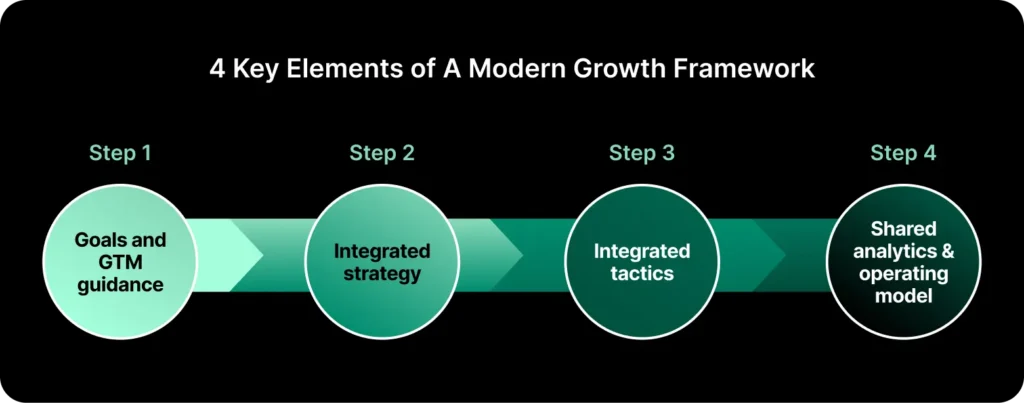
1. Goals and GTM guidance
Execution improves when direction is clear. Start by developing a set of shared growth goals and priorities that will anchor decisions.
Build a well-defined target audience to sharpen focus. Ask product strategy to clarify who the solution serves and why it matters. Develop a strong POV, positioning, and messaging to create consistency across touchpoints.
This layer establishes strategic coherence and prevents downstream fragmentation.
2. Integrated play strategy
With direction established, teams should then begin defining how growth shows up in the market.
Craft integrated plays that align brand and demand around specific audiences and objectives. They should span acquisition, retention, and expansion, ensuring continuity across the buyer journey.
This is where cross-functional coordination replaces siloed execution—and the integrated revenue growth becomes operational rather than theoretical.
3. Integrated tactics
Next, translate integrated strategy into coordinated execution.
Make sure your channels, content, enablement, and engagement models work together to reflect real buying behavior. Add and align personalization to stage, industry, persona, and use case. Use technology, data, and process to operate as a unified system.
Here, the integrated revenue growth framework becomes visible in market—not as isolated tactics, but as a cohesive experience buyers can feel.
4. Analytics and operating model
Finally, sustainable growth depends on shared measurement and continuous improvement. In other words, always keep the team and your goals on the same page.
Revenue-tied KPIs should replace isolated activity metrics. Teams should work from a single source of truth to improve decision-making. And cross-functional operating rhythms should support ongoing optimization.
This unification keeps the growth framework aligned and adaptive as markets evolve.
How this approach improves outcomes
When the components above work as one, results compound and teams gain:
- Greater efficiency through coordinated execution
- Stronger alignment across marketing, sales, RevOps, and customer teams
- More predictable growth by influencing buyers earlier, including within the dark funnel
- A more consistent customer experience across the lifecycle

Together, these outcomes demonstrate how to drive revenue across the B2B funnel in a structured, repeatable way.
Get help building a system that works
At 2X, we have helped many B2B organizations build and operationalize an integrated revenue growth framework aligned to how buyers actually buy. We understand where alignment erodes, where execution slows, and where operating models fail to scale.
Our approach connects strategy, execution, and RevOps into a single growth framework designed to drive revenue across the full lifecycle.
If you’re ready to move from intention to execution, we’d love to help you build a system that works.
Recent posts

Blog
Your stack is connected. Your revenue isn’t moving. That’s the GTM engineer problem.

Blog
The intent data trap: Why signal abundance is making GTM harder, not easier

Blog
Orchestrating your revenue system for the modern B2B buyer journey