March 2, 2026 | Blog
The hybrid future of ABM and demand generation

Most teams already operate some version of blending account-based marketing (ABM) and demand generation. In many organizations, an ABM motion focused on a short list of priority accounts runs alongside inbound, paid media, SEO, webinars, and outbound programs built to keep pipeline moving.
For many CMOs and CROs, the challenge is coordinating ABM and demand generation under tighter revenue targets and growing pressure to do more with less.
Because of this, the strategic question has shifted: how do we integrate ABM and demand generation into one hybrid model aligned to revenue? The real work is designing that model, so both motions drive shared, measurable outcomes.
Why hybrid programs are becoming the default
Several structural shifts have pushed ABM and demand generation into the same operating model.
ABM now extends beyond acquisition
ABM originally gained traction as a way to win net-new, high-value accounts. Today, teams apply ABM principles anywhere account value is concentrated, including retention, expansion, and complex land-and-expand motions.
When an account carries meaningful revenue weight, ABM thinking tends to follow it across the lifecycle, not just at the top of the funnel.
Most teams run multiple GTM motions
A single go-to-market (GTM) motion is increasingly rare. Many organizations support a mix of scalable demand programs, targeted ABM initiatives, product-led motions, and partner-led growth. This means that hybrid execution isn’t a trend. Instead, it reflects how modern revenue teams actually reach their market.
Personalization expectations have shifted
Buyers now expect relevance by default. That expectation applies across ABM and demand generation, even when the level of personalization differs. Personalization works best when treated as a dial. Some motions call for light segmentation and strong offers. Others require deep account and buying-group context. The key is knowing where to turn the dial up or down.
The real overlap between ABM and demand generation
ABM and demand generation are often discussed as if they rely on entirely different capabilities. In reality, most teams use the same core systems and channels across both, including content experiences, CRM and automation, intent data, paid media, sales-led outreach, events, and shared reporting.
The difference is not the tools themselves, but how they are applied. This shared foundation is what makes hybrid demand generation possible in practice.
A slider-based way to think about hybrid programs
High-performing teams stop treating ABM and demand generation as separate disciplines. Instead, they evaluate each program decision using a set of adjustable sliders tied to revenue goals and account tiers.
The most important sliders include:
- Targeting – From broad segments designed for reach, to tightly defined account lists and buying groups.
- Personalization – From segment-level relevance to account- or buying-group-specific experiences.
- Cross-functional alignment – From loose coordination to full orchestration across marketing, sales, SDR, and customer success.
- Channel mix – From primarily digital execution to a blend of digital and human-led engagement.
- Measurement – From lead-based early signals to account-level indicators that roll into pipeline and revenue.
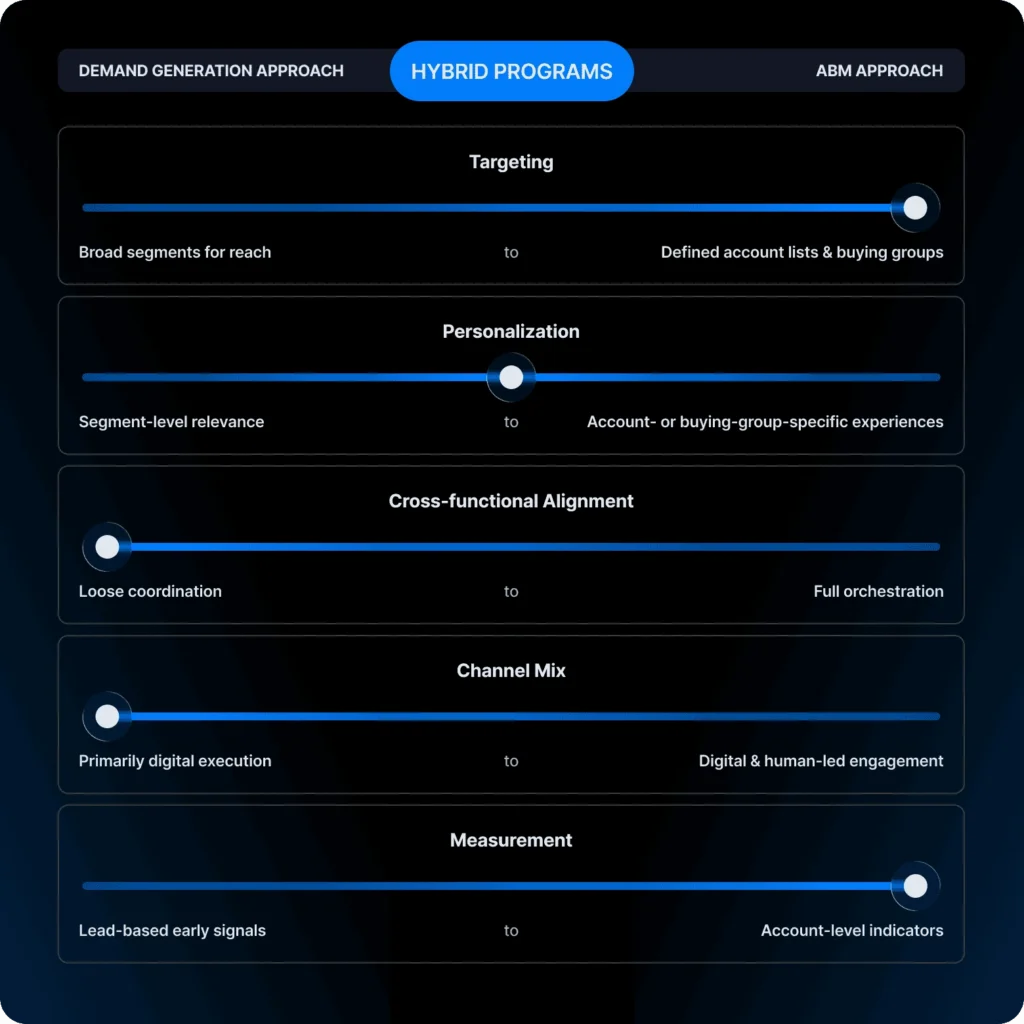
This approach allows teams to apply demand generation and B2B ABM tactics intentionally, without forcing artificial boundaries between motions.
Start with revenue, then design the strategy
When planning starts with revenue instead of tactics, alignment becomes much easier.
A simple way to structure the conversation is to break revenue into three buckets:
- New logo acquisition
- Retention and churn reduction
- Expansion through upsell and cross-sell
Each bucket can then be mapped to account tiers:
- Tier 1: A small set of mission-critical accounts
- Tier 2: High-fit accounts with meaningful upside
- Tier 3: The broader market where scale matters
This view clarifies where ABM-level focus is required and where demand generation should carry the load. It also gives leadership a clearer answer to budget questions without relying on generic benchmarks.
Matching the motion to the outcome
Hybrid programs perform best when the motion matches the business objective.
Demand generation is well suited for testing new segments, capturing broad in-market interest, and supporting pipeline at scale using proven B2B demand generation tactics.
ABM becomes essential when teams need to win competitive deals, move upmarket, coordinate complex buying groups, or drive expansion within strategic customers.
Most upmarket strategies require both. Demand generation helps surface intent and bring new stakeholders into the funnel. ABM provides the structure to coordinate outreach and experience at the account level.
Measurement: two starting points, one revenue view
Demand generation typically begins with leads. ABM begins with accounts. In a mature hybrid demand generation model, both should converge into the same revenue outcomes:
- Qualified opportunities
- Pipeline created
- Win rate
- Revenue closed
- Retention and expansion impact
Shared metrics make it possible to evaluate ABM and demand generation objectively and invest where each motion is most effective.
How to start if ABM is new to you
Teams new to ABM often try to scale too quickly. Early success usually comes from restraint.
A strong starting point includes choosing a narrow pilot, reusing existing content (and tailoring it to account priorities), and designing a cohesive experience for the buying group.
Early measurement should focus on account-level engagement, meetings created, and pipeline influenced. Once traction is visible, teams can scale by reducing intensity while preserving structure.
Creative as the multiplier
Creative quality remains one of the biggest performance gaps across demand generation and ABM programs.
The teams that stand out tend to share three traits: clarity on who they are, focus on who they serve best, and a point of view that reframes how buyers think about the problem.
When that foundation is in place, creative becomes a force multiplier across both scaled demand efforts and high-touch account programs.
The takeaway
High-growth teams aren’t choosing between ABM and demand generation. They’re building hybrid demand generation programs that match the motion to the goal, adjust intensity through clear operational sliders, and measure success through a unified revenue lens.
Blending ABM and demand generation into a single system isn’t about adding complexity. It’s about designing growth intentionally and coordinating the motions that already exist.
Ready to apply this to your own revenue model?
If your team is running ABM and demand generation in parallel, the next step is alignment. A clear hybrid approach helps you decide where to increase focus, where to scale efficiently, and how to measure both motions through the same revenue lens.
Recent posts

Blog
The Salesforce Lead object problem and what to do instead: A 2026 playbook

Blog
The execution gap: Why strategy is the illusion of growth

Blog
Your stack is connected. Your revenue isn’t moving. That’s the GTM engineer problem.