April 22, 2026 | White Paper
Why Most Companies Are Thinking About AI Cost All Wrong

Prefer to read offline or share internally?
Introduction
AI entered the market with a simple promise: more efficiency at lower cost.
That promise is directionally true. It is also incomplete.
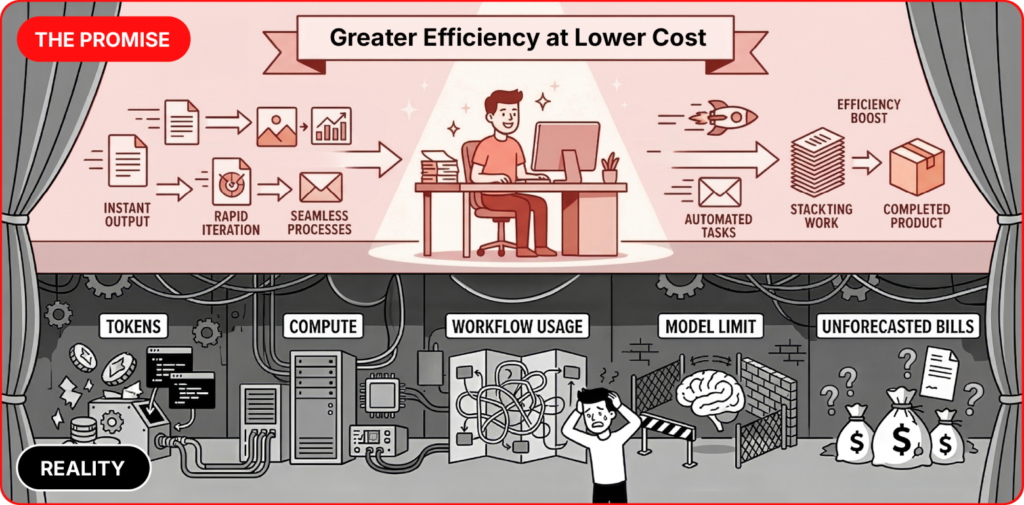
Many leaders expected AI to reduce labor, lower costs, and make services cheaper by default. Instead, they are facing a new kind of operating problem, one defined by tokens, compute, model usage, workflow runs, platform limits, and invoices that are difficult to forecast.
The issue is not that AI fails to create savings. In many cases, it does. The issue is that AI changes where cost sits, how it behaves, and who has to manage it.
What looked like a productivity story is quickly becoming an operating model story. Companies that continue to treat AI as a straightforward labor substitute will keep getting surprised by the economics that follow.
The Real Problem: Companies Are Asking the Wrong Question
Here’s a conversation happening in boardrooms and procurement meetings right now:
It is a reasonable question. And it is the wrong one.
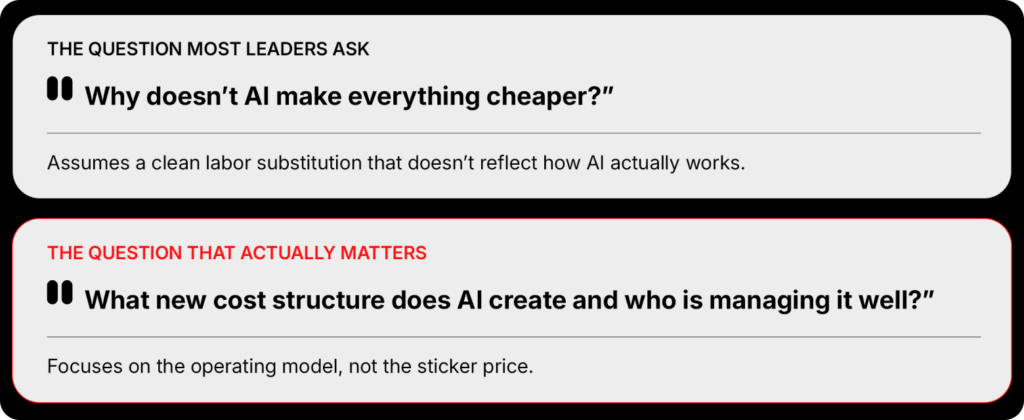
That question assumes AI simply replaces labor and removes cost. Swap in a model, take out a person, pass the savings along. Clean math. Simple story.
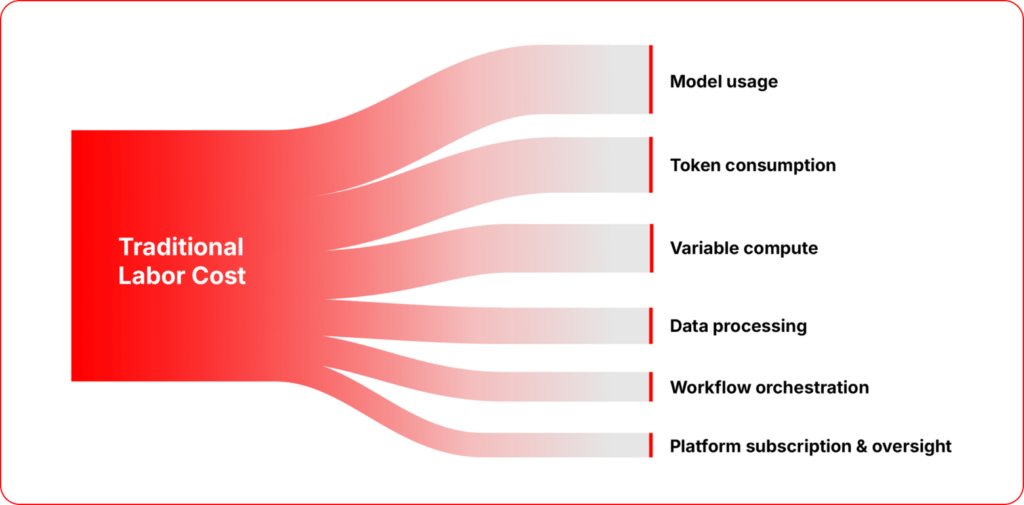
In reality, AI often redistributes cost into places that are less visible and harder to manage. The labor line goes down. But model usage, token consumption, compute, orchestration, data processing, subscriptions, and oversight start to accumulate. Those costs are real, variable, and most companies do not have a clean way to track them yet.
The more useful question is this: what cost structure does AI create, and how well are we managing it?
That is the question leaders should be asking before they judge whether an AI-enabled service, workflow, or partner is expensive.
AI Does Not Eliminate Cost. It Moves It.
AI can reduce manual effort. A task that once required three hours of human work may now take 30 minutes with the right model, prompt, and workflow. That gain matters.
But reduced effort does not mean cost disappears.
Instead, cost moves. It moves from salaries to usage-based billing. From fixed headcount to variable compute. From a single delivery function to a stack of platforms that meter activity in different ways. From visible labor to infrastructure that operates in the background until the invoice arrives.
That shift matters because it changes how a business needs to plan, budget, and govern.
Once AI becomes part of delivery, the company is no longer paying only for output. It is paying for a delivery system with its own economics, unit costs, constraints, and scaling behavior.
AI is not free productivity. It is an operating layer. Operating layers require management.
Four Reasons AI Cost Slips Out of View
The complexity sneaks up on you. Here’s how.
1. AI costs are variable.
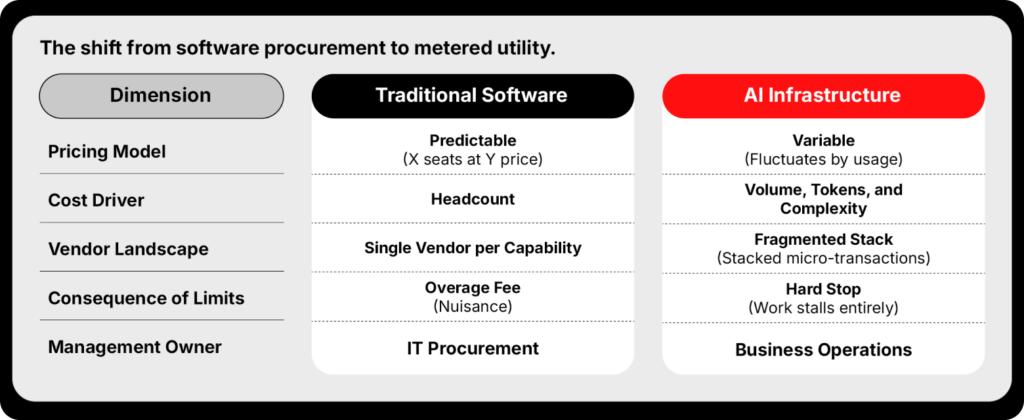
Traditional software is usually predictable: a set number of seats at a fixed monthly price. AI usage is different. Cost can change based on volume, model choice, prompt complexity, automation depth, and the amount of data moving through the system. That makes forecasting harder than most finance teams are used to.
2. AI costs are fragmented.
One tool charges for source data or enrichment. Another charges for model calls. Another charges for workflow runs. A fourth one cuts you off entirely when you hit a limit. It is rarely one bill and one owner. It is a patchwork of metered services that no one person is tracking end to end.
3. Platform economics are inconsistent.
Some vendors provide useful usage dashboards and clear reporting. Others provide hard limits with almost no visibility into how quickly you are approaching them. Others meter in ways that are not intuitive to the average business leader. Buyers are trying to compare platforms that do not behave the same way, and that creates blind spots in planning.
4. Poor guardrails turn cost into disruption.
When teams do not understand usage limits, work stalls without warning. When no one monitors workflow consumption, costs creep up without clear accountability. Under-buy, and teams get blocked mid-project. Over-buy, and you waste budget on capacity no one uses.
This is why AI cost management is quickly becoming less of a software procurement issue and more of a business operations issue.
Welcome to the Era of Token Nightmares
“Token nightmares” is the moment a company realizes AI cost is no longer theoretical.
It tends to show up when multiple tools are stacked together and each one meters usage differently. Data moves from one platform to another. Models get triggered at each step of a workflow. Enrichment tools charge per lookup. Orchestration layers charge per run. Suddenly the business is paying from two sides: data and compute, source and generation, automation and analysis. No one has a consolidated view of the total.
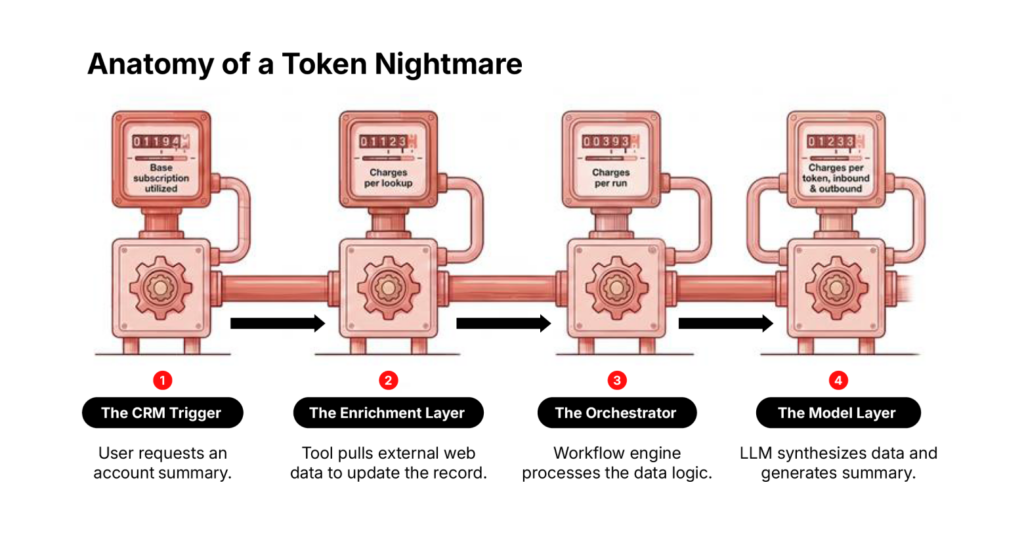
A CRM triggers an enrichment layer. The enrichment layer passes data into an orchestration tool. The orchestration tool calls a model. The model output moves into another platform for scoring, drafting, routing, or analysis. The cost is not one number. It is a stack of metered interactions, and each layer takes a cut.
The hidden challenge of AI is not just choosing the right model. It is understanding how many times that model is being called, what data is flowing through it, and how many tools are taking a cut along the way.
AI is starting to look less like software and more like a utility bill. And most companies have not built the meter yet.
The Goal Should Not Be “Cheapest AI”
When leaders fixate on finding the cheapest tool, they often underinvest in the very things that make AI valuable: the governance, the workflow design, the operating discipline that turns raw capability into repeatable business outcomes.
The cheapest model is not always the best choice. Sometimes the most capable model, used fewer times with better prompts and smarter workflow design, delivers more value at a lower total cost than a bargain-bin model called a thousand times with sloppy orchestration.

The real test is whether the AI-enabled operating model improves throughput, speed, quality, scalability, resource flexibility, or cost per unit of useful output. That is a systems question. It cannot be answered by comparing vendor rates in isolation.
AI should be judged the same way any serious operating investment is judged: not by what it costs per unit, but by the value it creates relative to the system it requires.
What Leaders Should Manage Instead
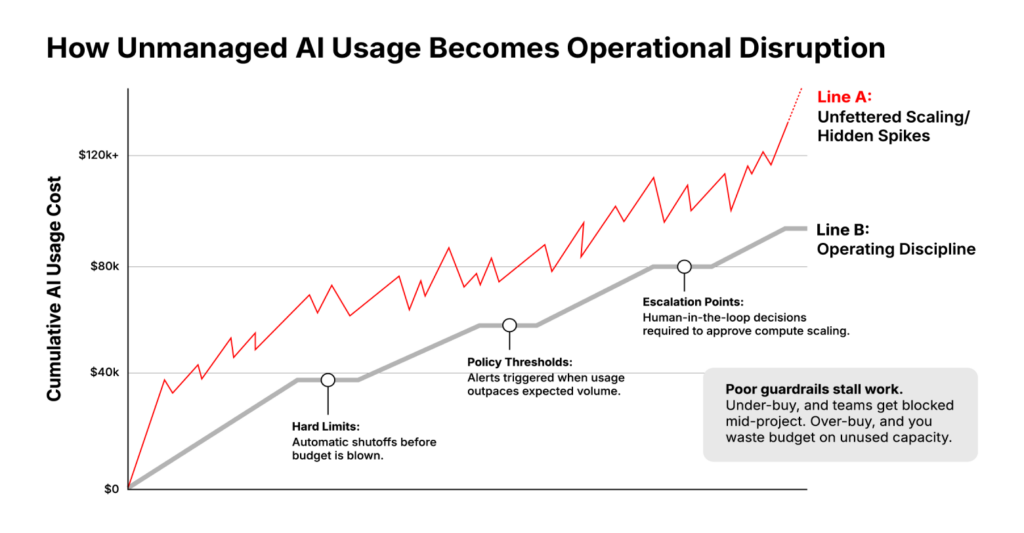
If cost management alone is the wrong lens, what is the right one? Leaders need to manage AI across five dimensions:
- Usage
Who is using what, how often, and for which workflows? You cannot manage what you cannot see. - Visibility
Do you have reporting on adoption, limits, workflow consumption, and remaining capacity? Or are you flying blind between invoices? - Guardrails
What are the policies, thresholds, and escalation points that keep usage productive and controlled? Who decides when to scale up, scale down, or shut something off? - Workflow design
Where is AI actually reducing work, and where is it adding complexity or redundant cost? Not every process benefits from automation. Some get worse. - Business impact
What are you getting in return? Faster delivery. Fewer bottlenecks. More output per person. Better quality. Lower dependency on incremental headcount. If you cannot connect AI usage to outcomes, you are just spending.
The companies that benefit most from AI will not be the ones that simply buy access. They will be the ones that manage usage like an operating discipline.
Five Questions Every Leader Should Ask Before Scaling AI
Before you add another tool, approve another workflow, or expand another pilot, answer these:
- What exactly are we paying for?
Seats? Tokens? Model calls? Compute? Data enrichment? Workflow runs? Integrations? If you cannot itemize the cost stack, you cannot manage it. - Where can cost spike unexpectedly?
Which teams, use cases, or workflows could create variable spend without warning? Where is there no ceiling? - What visibility do we have?
Can you see usage by person, by team, by workflow, by platform? Or does it show up as one opaque line item on a monthly invoice? - What guardrails are in place?
What stops a team from overspending, over-automating, or getting blocked by a hidden limit at the worst possible time? - What outcome are we optimizing for?
Are you trying to reduce cost? Increase capacity? Accelerate execution? Improve quality? Avoid headcount growth? The answer determines how you should evaluate every AI investment.
If you cannot answer these five questions clearly, you are not ready to scale. You are ready to get surprised.
The Bigger Point: AI Cost Management Is Now Part of the Operating Model
AI is not just a tool decision. It affects how work is designed, delivered, governed, and measured. That means AI cost management belongs inside a broader conversation about the operating model, not buried in a procurement spreadsheet.

The strongest organizations will be the ones that can decide, with discipline, what should remain human, what should be outsourced, what should be automated, and how to manage the economics across all three.
The companies that get this right will do more than save money. They will operate at a fundamentally different speed and scale than the ones still treating AI like a line item.
2X puts AI where it belongs: inside a live GTM engine, tied to pipeline outcomes, with the governance and workflow discipline to support it. If that’s the operating model you’re building toward, this is where to start.

Author
Lisa Cole
Recent posts

White Paper
How to navigate Wikipedia for AI visibility

White Paper
The search everywhere playbook: Building brand gravity in an AI-first world
White Paper
Aligning CFO and CMO for B2B enterprise success