February 26, 2026 | Blog
Why B2B demand generation has become a core growth function

For years, gated content, form fills, and marketing qualified leads (MQLs) shaped how B2B teams approached growth. This lead-centric model worked when buying decisions were simpler and pipelines moved faster. Today, buying committees are larger, sales cycles are longer, and revenue depends on more than lead volume alone.
In response, B2B demand generation has emerged as a core growth function. Businesses use it to connect awareness, education, and conversion into a single system focused on revenue impact. Done well, it aligns marketing, sales, and revenue teams around a shared goal: attracting and advancing high-value buyers.
So, when does a B2B business need a demand generation approach, and what does it take to execute one effectively? Let’s break it down.
What is demand generation?
At its core, B2B demand generation is a scalable, long-term approach for creating, capturing, and converting demand across the entire buyer journey—measured by buying intent and revenue impact, not form fills.
It emphasizes three core outcomes:
- Building brand awareness so buyers recognize and trust you before they are ready to buy.
- Educating the market and shaping how buyers think about their problem and your solution.
- Driving revenue by aligning marketing activity directly with sales goals.
When do you need a demand generation strategy?
As buying cycles grow longer and more complex, traditional lead-focused models often start to show their limits. The signs are usually hard to miss and tend to surface in the same familiar ways:
- Sales says the leads are low quality.
When MQLs fail to open real opportunities, the problem is rarely volume. More often, the issue is intent or fit. - Growth depends on outbound or paid spend.
If pipeline slows the moment ad spend drops, demand is being rented rather than built. - Sales cycles stretch or deals stall.
When prospects disengage mid-funnel, it’s often because they are still aligning internally or lack clarity to move forward. - Competitors own the conversation.
When buyers are not engaging with your brand, they are engaging with someone else’s. - Marketing and sales feel misaligned.
When marketing is measured on lead volume and sales is measured on revenue, friction happens.

If these patterns sound familiar, it may be time to shift from lead volume to a demand generation model built around revenue impact.
How demand generation fixes what’s not working
Demand generation is not a single campaign or channel. It serves as a repeatable growth system that works to improve marketing outcomes through the following key elements:
A clear ICP and buyer journey
Effective B2B demand generation starts with audience precision. A well-defined ideal customer profile (ICP) and a realistic journey ensure that messaging, content, and channels reflect how real buyers research, evaluate, and decide.
Content that supports conversion
Buyers need different information as they move forward. A strong content strategy accounts for these shifts in intent by serving them with the necessary type of messaging at each stage:
- Early stage: Thought leadership and problem-awareness content.
- Mid stage: Case studies, webinars, and solution-oriented education.
- Late stage: Competitive comparisons, proof points, and sales enablement assets.
Multi-channel distribution
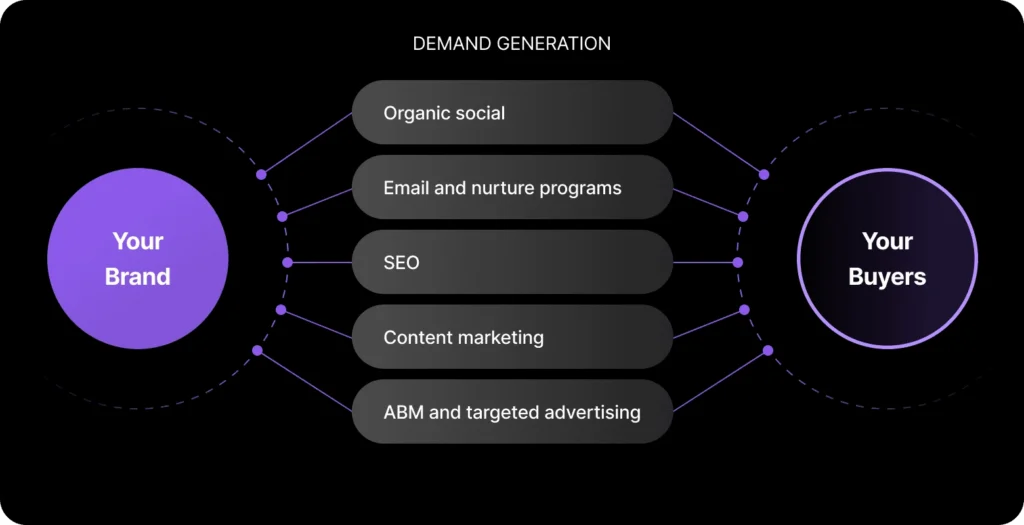
Modern buyers rarely stick with a single channel when considering a purchase. B2B demand generation ensures that your message reaches buyers across complementary touchpoints including paid and organic social, email and nurture programs, SEO and content marketing, and account-based marketing and targeted advertising.
Sales and marketing alignment
B2B demand generation succeeds when marketing and sales operate as one revenue team working toward the same outcomes. Alignment typically includes agreement on:
- What signals indicate high buying intent.
- How buyers are nurtured and when handoffs should occur.
- KPIs tied to pipeline contribution, deal velocity, and revenue.
A focused, integrated MarTech stack
Technology supports B2B demand generation when it creates visibility and insight across the funnel. Common components include marketing automation platforms such as HubSpot or Marketo, CRMs like Salesforce or HubSpot CRM, intent data tools including 6sense or Demandbase, and ad platforms like LinkedIn Ads and Google Ads.
While the tools matter, what’s most important is using MarTech smartly in order to boost pipeline performance.
Demand generation is a growth engine, not a tactic
B2B demand generation evolves traditional lead generation by creating a system designed for trust, relevance, and long-term revenue impact.
For B2B teams ready to move beyond short-term volume and toward sustainable growth, demand generation becomes the engine that supports every stage of the revenue lifecycle.
Recent posts

Blog
The hybrid future of ABM and demand generation

Blog
The B2B growth reset, part 2: Building a modern framework
Blog
The B2B growth reset, part 1: Why the old model no longer works