February 26, 2026 | Blog
The B2B growth reset, part 1: Why the old model no longer works

The “old” B2B growth playbook most teams still run
For years, the traditional B2B growth playbook worked well enough. In many organizations, it still defines how teams operate.
Targeting begins broadly, anchored in TAM math and static personas. Marketing is measured on MQL volume. Sales engages once leads are qualified, focusing on product conversations and late-stage conversion. Messaging emphasizes features and differentiation.
Execution follows predictable patterns:
- Gated content designed to capture early demand
- Mass email and nurture programs pushing leads through the funnel
- Cold outbound carrying a growing share of pipeline responsibility
- Trade shows and one-to-many campaigns absorbing significant budget
Behind the scenes, go-to-market (GTM) teams work in silos. Each function optimizes its own metrics, often without a shared view of impact. The emphasis stays squarely on acquisition and active demand.
If this sounds familiar, it’s because it’s still the default operating model across B2B—for a long time, it delivered.
But many teams are starting to feel friction they can’t fully explain.
If that’s you, you’re in the right place.
Signs your growth playbook isn’t working as well as it should
The strain rarely shows up all at once. Growth slows. Targets feel heavier. More effort is required just to maintain momentum. The playbook that once felt dependable begins to feel misaligned with reality.
Marketing leans harder into activity. Sales increases outbound pressure. RevOps spends more time reconciling dashboards than shaping decisions.
Why? Because the market evolved, but the model largely stayed the same.
When an outdated B2B growth playbook begins to strain, a quick self-check can help.
Are you seeing any of the following?
- Rising customer acquisition costs
- Slower pipeline velocity
- Lower win rates
- Smaller average deal sizes
- Missed pipeline or revenue targets
- Increasing pressure on outbound
- Conflicting metrics and dashboards
- Misalignment across Marketing, Sales, and RevOps
- Declining customer experience or churn risk
Seeing a few of these is manageable. Seeing several at once usually signals structural shifts that will soon enough become impossible to ignore.
Why the old playbook isn’t working
The symptoms above are predictable outcomes of structural shifts in buyer behavior, GTM, and team structure that the old growth playbook wasn’t built for.
Let’s dig into these three primary structural shifts:
1. Buyer behavior has changed
The data leaves little room for interpretation.
- Roughly two-thirds of the B2B buying journey is digital, meaning influence happens before a lead exists.
- 70% of the journey is complete before buyers engage sales, often with preferences already forming.
- The average buying decision involves 10 people across four departments, increasing internal friction and scrutiny.
- 65% of buyers avoid sharing contact information, and only 5–10% of an ICP is actively in market at any given time.
- When buyers do engage, 84% choose the first vendor they contact.

Demand now forms quietly. Committees move carefully. Visibility comes late.
But the old playbook, which was designed around early buyer capture and linear funnels, now struggles to influence outcomes already in motion.
2. GTM has changed
When it comes to buying today, efficiency carries real weight. Budget scrutiny is higher, and growth investments are expected to show measurable impact.
At the same time, GTM complexity has expanded. RevOps teams manage larger tech stacks alongside stricter privacy, security, and data requirements. Dark funnel influence is also growing. Content saturation is widespread. Buyers bring B2C expectations into B2B experiences, and competitors are steadily improving execution.
The old playbook was built for a simpler time, so it struggles to compete in a new landscape defined by complexity. The result? Inefficiency compounds quickly.
3. Teams are still structured for the old reality
As noted earlier, the market has evolved, but many internal team structures have not.
Marketing, sales, and RevOps still operate with disconnected goals and metrics. Reporting stays fragmented, and execution breaks down across handoffs. Even strong individual performance fails to translate into sustained momentum.
The system itself becomes the constraint—and a playbook crafted for siloed functions and sequential handoffs cannot produce coordinated, system-level growth in a market that now demands it.
Why doing more of the same doesn’t fix the problem
When results soften, the instinct is often pushing harder. More campaigns. More outbound. More tools. These actions increase activity but rarely resolve structural misalignment.
Additional campaigns do not unify teams. More outbound does not create demand that isn’t there. New tools often increase complexity faster than clarity.
As a result, teams often fall into siloed heroics. Individual effort rises, but results plateau.
Why a modern growth framework is required
Sustainable success depends on treating revenue as a system, not a collection of disconnected activities.
A modern growth framework aligns teams around how buyers actually move, connects strategy to execution, and anchors decisions in revenue outcomes. Instead of optimizing isolated funnel stages, teams operate across the full buyer journey.
At its core, this is a revenue growth framework designed to compound impact over time rather than reset every quarter.
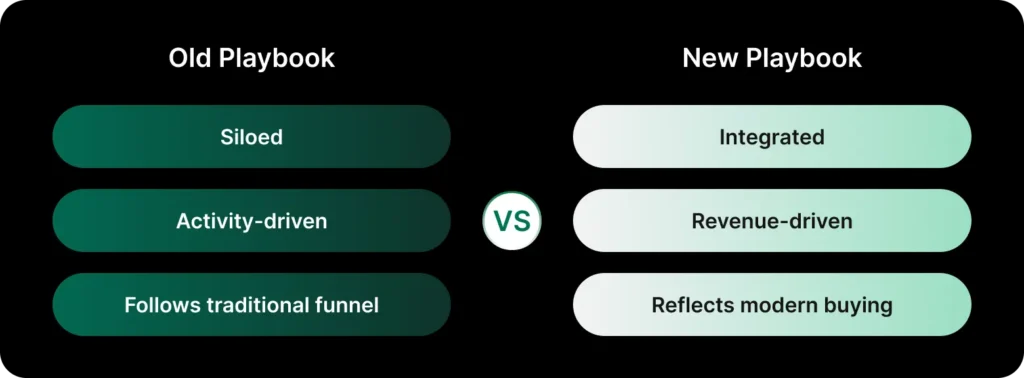
Conceptually, the update seems straightforward. Evolve the playbook from a siloed, activity-driven, and funnel-only focus to one that’s more integrated, revenue-driven, and reflective of modern buyer behavior.
The thing is, changing your operating model is no easy task. Luckily, it’s doable with the right information and experts at your side. It starts with knowing what a modern revenue growth framework should look like, and how B2B teams put it into practice.
Recent posts

Blog
The hybrid future of ABM and demand generation
Blog
The B2B growth reset, part 2: Building a modern framework

Blog
Why B2B demand generation has become a core growth function