February 12, 2026 | Blog
Blending ABM and demand generation, part 2: Hybrid marketing in action
B2B growth today depends on knowing when to scale reach and when to concentrate effort on the accounts that matter most. Many teams understand this in principle. Execution is where momentum tends to slip.
Hybrid marketing often looks great on a slide deck but feels messy in real life. Too often, strategy and execution drift apart once teams move from planning to action. Content gets created without a clear purpose while channels operate alongside each other rather than in sync. Meanwhile, the organization’s data lives in separate systems without coming together to tell a coherent story.
In part 1, we explained why blending ABM and demand generation is essential, while this guide focuses on how to operationalize that strategy in real-world programs.
Content strategy for the continuum
One of the biggest places hybrid programs tend to break down is content development. Too often, assets are created in isolation, without a clear link back to the overall go-to-market (GTM) strategy. When that happens, strong content gets underused and messaging starts to feel disjointed from one campaign to the next.
In a hybrid model, content supports different demand motions while still telling a consistent story.
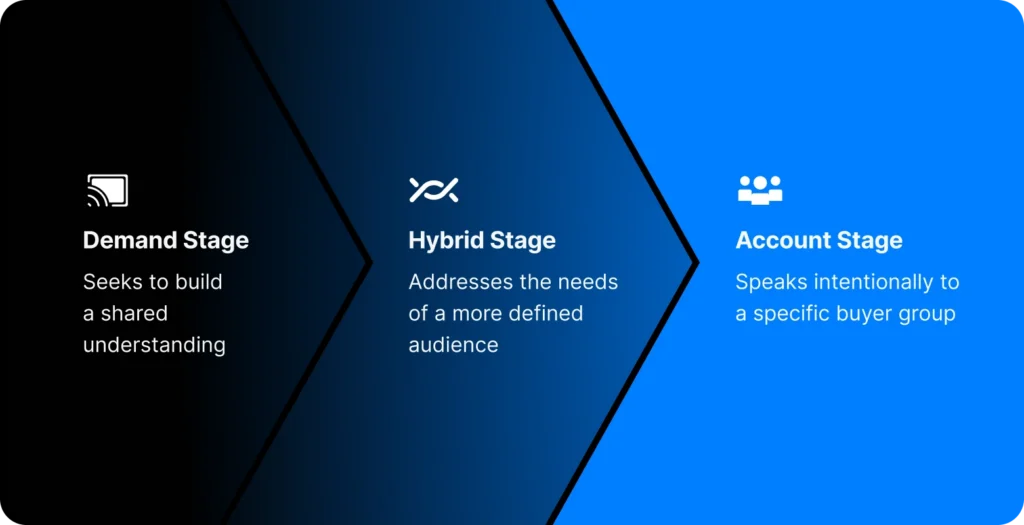
A useful way to think about content across the continuum is progression:
- Early-stage demand generation
Content establishes the problem space and builds credibility. The goal is shared understanding, not immediate conversion. - Segment- and account-level programs
Content becomes more specific, addressing recognizable scenarios, constraints, or priorities within a defined audience. - High-focus ABM execution
Content reflects the account’s context directly. It feels intentional, relevant, and clearly designed for the buying group involved.
Teams that execute this well plan for reuse with variation. Core ideas are built to travel across the continuum, gaining relevance as engagement deepens.
Multi-channel orchestration
Buyers don’t stick to one channel, and your marketing shouldn’t either. Conversations often start in one place and continue somewhere else. A hybrid program works when it supports that reality instead of forcing buyers into a single path, where the goal is to keep every interaction connected as accounts move closer to revenue.
Channel selection should follow the demand motion. A broad B2B demand generation strategy relies on digital reach for awareness and early interest. As the focus narrows, interactions need to feel more deliberate:
- Use personalized landing pages and adaptive content to keep engagement moving.
- Introduce conversational tools when buyers need quick answers.
As intent becomes clearer, sales outreach takes on a bigger role. Targeted platforms help teams connect with the right people at the right time, where they can:
- Prioritize direct outreach for accounts showing meaningful signals.
- Add high-touch moments, like physical mail, when focus and deal value justify it.
Paid media should evolve across the continuum to support progress, not chase impressions, so teams should:
- Adjust messaging based on account focus level.
- Align spend with opportunity, not volume.
Revenue operations as the engine for hybrid programs
Revenue operations (RevOps) sit at the heart of effective hybrid strategies. By connecting marketing, sales, technology, and analytics, RevOps ensures every team is aligned around one goal: sustainable revenue growth powered by data.
For hybrid programs to work, you need unified workflows. Account details, lead activity, and intent signals need to flow freely across systems. Without that foundation, even the smartest strategies can stall.
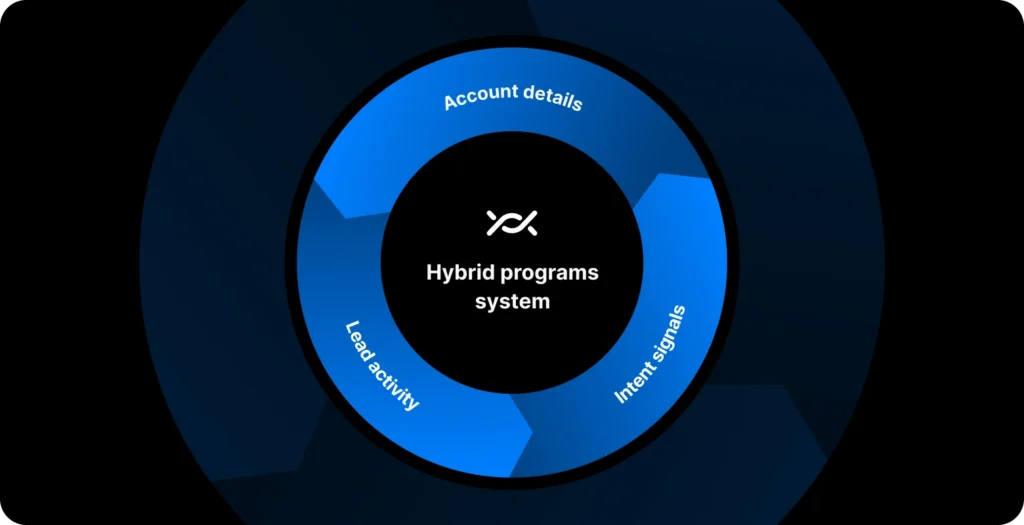
How you manage leads and accounts depends on your demand motion. Demand generation often works like a wide net that surfaces engaged accounts. When those accounts show real promise, they can be moved into targeted ABM efforts, forming part of an integrated demand generation approach that blends broad and account-based strategies. Intent data helps with prioritization, but it’s a signal to inform decisions, not a crystal ball.
Scoring and tracking evolve along the customer journey. Early-stage programs track individual engagement because that’s what matters most, while ABM tracks activity across buying teams. Routing reflects that difference: Individual leads move on their own, while ABM accounts progress together.
Be smart about where you invest in data. Comprehensive data coverage makes sense when an account reaches the sales-accepted stage, and you need to engage the full buying committee. Earlier in the journey, lighter data is usually enough. The key is balancing cost against value.
Measurement and analytics framework
Measurement must be defined before campaigns launch. What success looks like depends on the demand approach.
Demand generation often focuses on engagement and pipeline contribution. ABM programs track account engagement and buying team coverage. Hybrid programs need visibility into how different motions influence revenue over time.
Some things are easier to measure than others. Visits to your pricing page or demo requests give you clear signals that an account is moving forward. But relationship strength and word-of-mouth influence? Those are harder to quantify, even though they often matter just as much. Let measurement guide your decisions without letting it box you in.
Good reporting keeps everyone aligned. Leadership wants to see what’s working at a high level, while teams need campaign details they can act on. Marketing influence reporting connects activity to outcomes without oversimplifying attribution.
Hybrid operations, media, and technology
Operationalizing a hybrid B2B marketing strategy requires managing multiple operational models at once. This is where account-based and demand generation strategies intersect.
Demand generation tracks individual leads and market signals, while ABM focuses on buying teams and specific accounts. Success comes from knowing when to use each and moving accounts between them smoothly.
1. Operational model:
- Use demand generation for brand awareness and 1:Many motions
- Deploy ABM for 1:Few and 1:1 execution
- Promote high-potential accounts from demand generation into ABM
- Flag ABM accounts in CRM to prevent overlap
- Automate transitions between programs
2. Media strategy:
- Move beyond last-click attribution. Media builds reach and momentum
- Align broad campaigns with targeted ABM efforts
- Make messaging complement outreach, not compete with it
- Prioritize sequencing and frequency over impressions
- Align sales and marketing on media’s role
- Use orchestration platforms for automation with strategic control
3. Technology requirements:
- Marketing automation for campaign management
- Account intelligence for behavior visibility
- Sales engagement platforms for targeted outreach
- Advertising platforms with account-based capabilities
- Clean data flow (integration beats tool count!)
- Unified account views to reduce manual work
- Choose tools for today’s needs, not aspirational ones
Your path forward
Building a successful hybrid program isn’t a one-and-done effort. Markets shift, buyer behavior evolves, and competitive pressure changes. The demand continuum gives you the flexibility to adjust without rebuilding your entire strategy. Regular reviews and cross-functional learning help you scale what works and cut what doesn’t.
Blending ABM and demand generation works because it mirrors how growth happens through coordinated effort, shared signals, and disciplined focus. When supported by the right frameworks and operations, marketing becomes a consistent driver of revenue impact rather than a collection of disconnected activities.
Recent posts

Blog
The hybrid future of ABM and demand generation

Blog
The B2B growth reset, part 2: Building a modern framework
Blog
The B2B growth reset, part 1: Why the old model no longer works